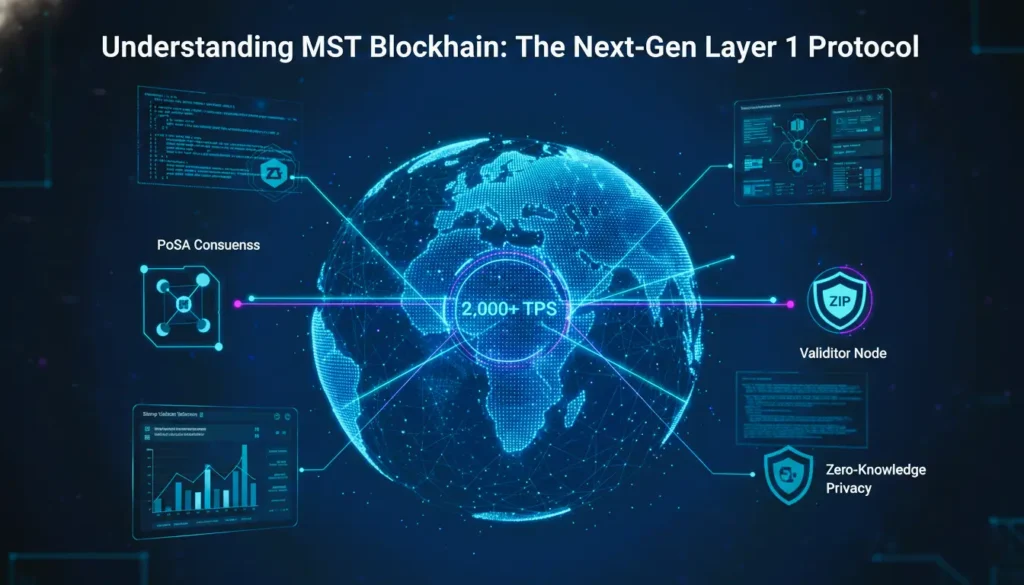
In the current landscape of decentralized technology, most blockchain stands out as high-performance Layer 1 (L1) platforms designed for massive scalability and developer flexibility. Unlike legacy networks that struggle with high fees, the MST blockchain utilizes a Proof of Staked Authority (PoSA) consensus to deliver blazing-fast 3-second block finality and a throughput exceeding 2,000 TPS.
Built by MasterStroke Technosoft, this ecosystem is engineered to bridge the gap between traditional enterprise systems and the Web3 world. Maintaining full EVM compatibility allows developers to deploy Solidity-based smart contracts using familiar tools like MetaMask and Hardhat without any retooling.
Core Technical Pillars of the MST Ecosystem
The strength of the MST blockchain lies in its unique integration of security and user experience:
- Parlia Consensus Engine: Ensures network integrity through a distributed set of validators, providing a “trustless” foundation for financial and data transactions.
- SARAL Protocol: A “no-code” gateway that simplifies Web3 access, making it easier for traditional businesses to integrate blockchain without deep technical expertise.
- Zero-Knowledge (ZK) Privacy: Utilizes advanced cryptographic proofs to verify data authenticity while keeping sensitive information private—a critical feature for enterprise compliance.
Real-World Utility and Use Cases for MST Blockchain
Beyond theoretical applications, MST Blockchain is currently powering several high-growth sectors through its robust infrastructure.
Enterprise and Supply Chain Transparency
Organizations use the MST blockchain to create an immutable “proof-of-record” for logistics. By linking traditional ERP systems (like SAP or Oracle) to the ledger, companies can track product movement from manufacturing to the end consumer, virtually eliminating the risk of counterfeiting.
Decentralized Finance (DeFi) and MSTC Tokenomics
The native utility coin, MSTC, serves as the lifeblood of the network. Following a “fair-launch” principle inspired by Bitcoin, MSTC is distributed only through validation rewards—meaning no pre-allocations or team reserves. This ensures a decentralized and transparent economic model where every participant contributes to the network’s value.
How to Participate in the MST Network
One of the most innovative aspects of blockchain is its “Human-Friendly Onboarding.” The platform offers the world’s first no-code validator experience, allowing non-technical users to support the network and earn protocol incentives by running a node through a simple interface.
Developer Grants and “ChainBuilders.”
To foster innovation, the MST blockchain “ChainBuilders” program offers grants ranging from $50,000 to $500,000. These incentives are designed to support everything from experimental side projects to production-ready decentralized applications (dApps) targeting global audiences.
Frequently Asked Questions (FAQs)
What is the MST blockchain?
Mst blockchain is an open-source, Layer 1 blockchain platform that provides the foundation for decentralized applications, digital assets, and enterprise data solutions. It is known for its high speed, low gas fees, and compatibility with the Ethereum Virtual Machine (EVM).
How does the MST consensus mechanism work?
The network uses a Proof of Staked Authority (PoSA) model. This hybrid approach combines the security of staking with the efficiency of designated validators, resulting in faster transaction confirmation times compared to traditional Proof of Work systems.
Is there a token for the MST blockchain?
Yes, the native token is MSTC. It is used for paying transaction (gas) fees, securing the network through staking, and participating in on-chain governance decisions.
Can I build on MST if I am an Ethereum developer?