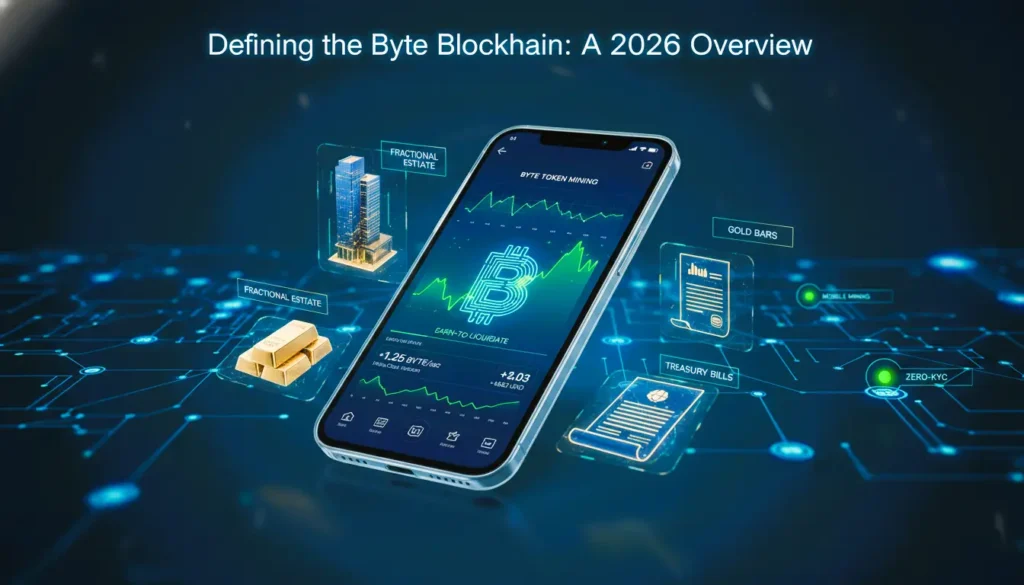
In the rapidly evolving landscape of 2026, the byte blockchain has emerged as a specialized Layer 1 (L1) protocol optimized for “micro-compute” and real-world asset (RWA) integration. Unlike general-purpose blockchains that struggle with mobile optimization, the Byte blockchain is architected to run seamlessly on smartphones, enabling a “mine-on-the-go” ecosystem that has attracted millions of users globally.
Launched from the tech hubs of Dubai, the platform differentiates itself through its Zero-KYC, No-Vesting model, allowing for 100% unlocked mining rewards. By Q1 2026, the network will have transitioned to centralized exchange listings, positioning the native BYTE token as a high-liquidity asset for the retail-focused decentralized web.
The Technical Architecture of Byte Blockchain
The network’s efficiency is rooted in its unique “Byte-Engine,” which allows for high-throughput transactions without the heavy hardware requirements of traditional PoW networks.
- PoSA (Proof of Staked Authority): Combines the security of designated validators with a community-driven staking model.
- Mobile-First Consensus: An optimized protocol that allows users to contribute to network security with minimal battery and data consumption.
- EVM Compatibility: Full support for Ethereum-based tools, enabling developers to bridge DApps from Ethereum or BNB Chain to the byte blockchain with zero code changes.
Key Features of the Byte Blockchain Ecosystem
To compete in the crowded L1 market, the Byte blockchain offers several distinct advantages for both developers and daily miners.
1. Decentralized Exchange (ByteSwap)
The ecosystem features its own native DEX, ByteSwap, allowing users to instantly convert mined BYTE coins into USDT once they reach specific network ranks. This creates an immediate “Earn-to-Liquidate” cycle that drives high daily active user (DAU) counts.
2. Real-World Asset (RWA) Integration
In early 2026, Byte Exchange announced a major infrastructure update designed to bring compliant, income-generating assets on-chain. This allows users to hold fractionalized versions of physical assets, such as real estate or treasury bills, directly on the byte blockchain.
3. No-Vesting Mining Model
One of the most disruptive aspects of the project is its rejection of traditional “lock-up” periods.
- Daily Yield: Users typically mine at a speed of 24 BYTE per day.
- Instant Portability: Unlike competitors like Pi Network, Byte emphasizes fully unlocked rewards from day one, reducing the barrier to entry for new crypto users.
Byte Blockchain vs. Competitors: 2026 Comparison
| Feature | Byte Blockchain | Pi Network | Sidra Chain |
| Launch Phase | Q1 2026 (Live) | Enclosed Mainnet | Mainnet Transition |
| Mining Barrier | Mobile App (1-Click) | Mobile App (24h) | Web/App Mining |
| KYC Requirement | None (Optional for Rank) | Strict Mandatory | Required |
| Listing Status | Major CEXs (2026) | Limited/IOM | Regional Exchanges |
| Target সাধারণ কিছু প্রশ্নের উত্তর | RWA & Retail Traders | Global Social Mining | Islamic Finance |
Frequently Asked Questions (FAQs)
What is the current value of the Byte Blockchain coin?
As of Q1 2026, the initial trading value of 1 BYTE has been estimated between $0.70 and $0.78. However, like all digital assets, the price fluctuates based on market demand and listing volume on centralized exchanges.
How do I withdraw my mined BYTE coins?
To withdraw your coins, you must reach Rank 3 within the Byte App. Once achieved, you can use the integrated ByteSwap DEX to convert your BYTE into USDT or transfer them to a supported external wallet.
Is the Byte blockchain safe for beginners?
The byte blockchain is designed specifically for beginners, offering a “no-code” and “no-KYC” experience. However, users should always use official links (e.g., app.byteblockchain.org) and never share their private keys or seed phrases with third parties.
Is Byte Blockchain officially affiliated with Grok or xAI?
No. While there is a community-driven “Byte” meme token inspired by Grok AI, the Byte blockchain Layer 1 project is a separate infrastructure initiative focused on mobile mining and RWA tokenization.
Understanding the Bitcoin Blockchain: The Foundation of Digital Scarcity
The bitcoin blockchain is the world’s first decentralized, distributed ledger technology (DLT). Launched in 2009 by the pseudonymous Satoshi Nakamoto, it serves as a public record of every transaction ever made using the Bitcoin currency. Unlike traditional banking systems, the bitcoin blockchain operates without a central authority, relying instead on a global network of nodes to maintain its integrity.
In 2026, the network is no longer seen just as “digital gold.” With the maturation of Layer 2 solutions and protocol upgrades, the Bitcoin blockchain has evolved into a secure settlement layer for everything from financial contracts to decentralized identity.
The Technical Pillars of the Bitcoin Network
To maintain security and decentralization, the network utilizes several core components:
- Proof of Work (PoW): The consensus mechanism where “miners” use specialized hardware (ASICs) to solve complex mathematical puzzles, securing the network and earning rewards.
- SHA-256 Hashing: The cryptographic “fingerprint” that ensures data within a block cannot be tampered with without altering every subsequent block.
- 10-Minute Block Time: A built-in difficulty adjustment that ensures a new block is added to the Bitcoin blockchain approximately every ten minutes, regardless of the total hash rate.