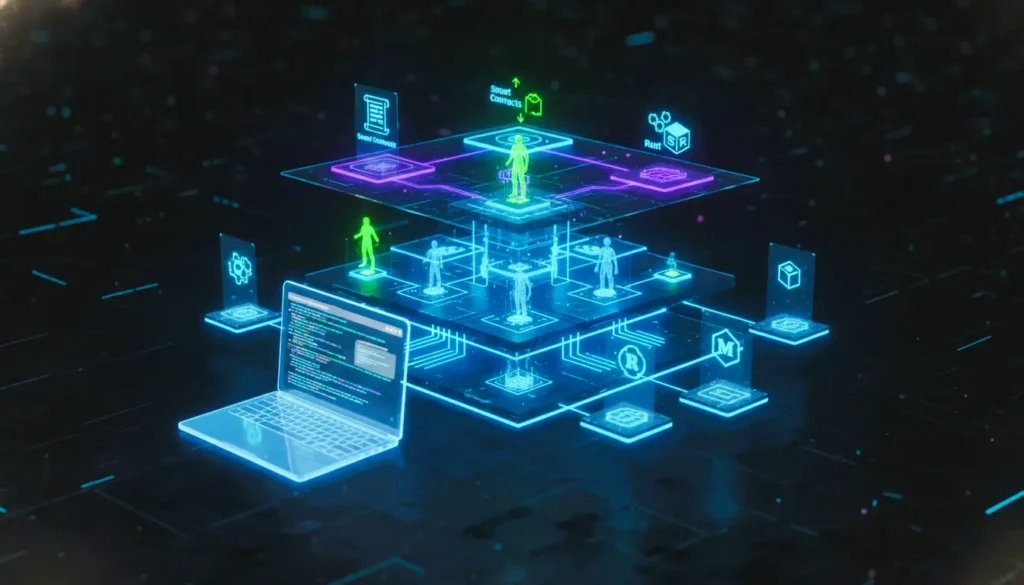
Understanding the blockchain tutorial landscape requires moving beyond simple definitions. A blockchain is a distributed, immutable ledger that uses cryptographic hashing to secure data across a global network of nodes. In 2026, this technology has matured from speculative finance into a robust infrastructure for AI verification, supply chain transparency, and digital identity.
To master this field, you must understand the “Blockchain Trilemma”: the constant balance between security, scalability, and decentralization.
Step 1: Understanding the Core Architecture
Every blockchain tutorial must begin with the three pillars of the network:
- Blocks: Containers for data (transactions, smart contract code).
- Nodes: Individual computers that maintain the network and validate new entries.
- Miners/Validators: Participants who solve cryptographic puzzles (Proof of Work) or stake assets (Proof of Stake) to reach consensus.
Technical Skills: Building Your First Smart Contract
Modern blockchain development focuses on “programmable trust.” By 2026, the industry will have standardized around a few key languages that any comprehensive blockchain tutorial should cover.
Choosing Your Development Environment
- Solidity (Ethereum/EVM): The gold standard for smart contracts. If you want to build on Ethereum, Base, or Polygon, mastering Solidity is non-negotiable.
- Rust (Solana/Polkadot): Preferred for high-performance applications and DePIN (Decentralized Physical Infrastructure Networks).
- Move (Aptos/Sui): A newer language designed specifically for asset safety and parallel execution.
Deploying a “Hello World” Contract
To complete this blockchain tutorial practically, follow these steps:
- Install a Wallet: Download Phantom or MetaMask and switch to a “Testnet” (Sepolia or Devnet).
- Get Test Tokens: Use a “faucet” to receive free, non-value tokens for gas fees.
- Use an IDE: Open Remix Project (for Solidity) and write a simple script to store a string on-chain.
- Compile & Deploy: Hit deploy and watch your transaction appear on a block explorer.
Intermediate Concepts: Oracles and Layer 2 Scaling
As you progress in your blockchain tutorial, you will encounter the limitations of Layer 1 (L1) networks.
The Role of Layer 2 (L2) Solutions
L2s like Arbitrum, Optimism, and Starknet handle transactions “off-chain” and settle them on the main ledger. This reduces fees by 99%, making blockchain viable for retail use.
Connecting to the Real World via Oracles
Blockchains are “closed loops”—they cannot see outside data (like weather or stock prices) natively. Chainlink Oracles act as the bridge, feeding external data into smart contracts securely.
Frequently Asked Questions (FAQs)
Is this blockchain tutorial suitable for non-coders?
Yes. While the “Development” section requires coding, the first half focuses on “Conceptual Literacy,” which is essential for project managers, investors, and digital marketers working in the Web3 space.
How long does it take to learn blockchain?
A basic blockchain tutorial can be completed in a weekend. However, becoming a proficient smart contract developer typically takes 3 to 6 months of consistent practice with Rust or Solidity.
What is the best language to start with in 2026?
For most beginners, Solidity is the best starting point due to its massive documentation, large community, and compatibility with the Ethereum Virtual Machine (EVM) ecosystem.
Do I need a powerful computer for this blockchain tutorial?
No. Most development happens in cloud-based IDEs like Remix or via lightweight CLI tools. You only need a powerful machine if you intend to run a “full node” or mine high-difficulty assets.