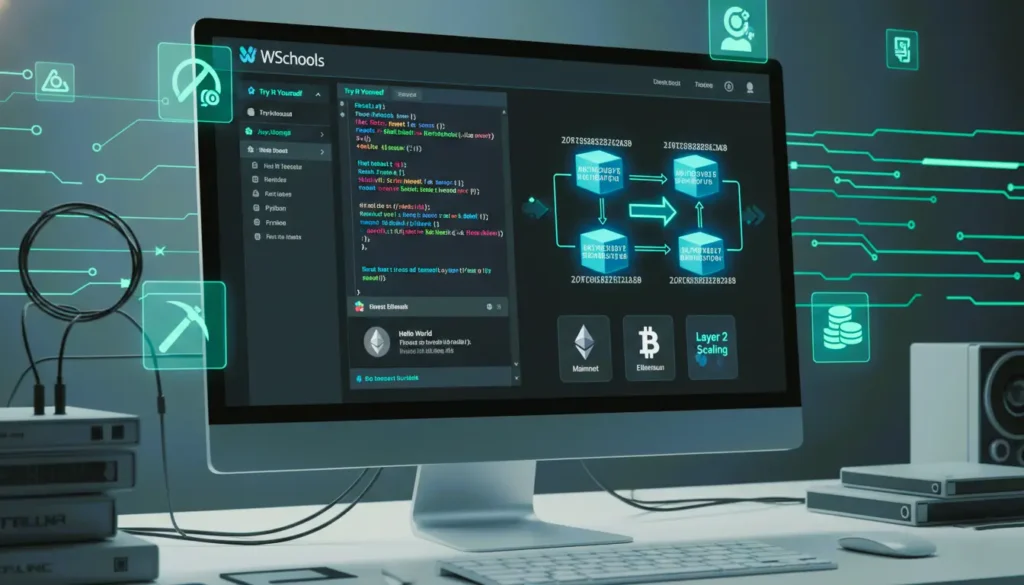
For those entering the Web3 space, the blockchain tutorial on W3Schools serves as the gold standard for accessible, structured learning. Much like their legendary web development guides, the W3Schools blockchain curriculum breaks down complex cryptographic concepts into digestible modules. In 2026, this tutorial will have been updated to include not just theoretical history but practical implementation for modern Layer 1 and Layer 2 networks.
The core of the blockchain tutorial at W3Schools focuses on the “three pillars”: decentralization, immutability, and transparency. By following this path, students move from understanding “What is a Block?” to “How do I secure a network?” without the fluff found in many paid bootcamps.
Why W3Schools is the Starting Point for Developers
- Try It Yourself Editor: Test blockchain data structures directly in your browser.
- Progressive Learning: Move from basic data blocks to advanced smart contracts.
- Language Agnostic: While primarily focusing on Solidity, the tutorial explains how Python and JavaScript interact with the ledger via web3.js.
Technical Deep Dive: Blocks, Hashes, and Consensus
A major section of the blockchain tutorial on w3schools is dedicated to the math that makes the system “trustless.”
The Anatomy of a Block
In the W3Schools model, every block is taught as a data object containing:
- Data: The actual transaction details.
- Hash: A unique digital fingerprint (often SHA-256).
- Previous Hash: The link that creates the “chain,” ensuring that changing one block invalidates all subsequent ones.
Understanding Consensus Mechanisms
The blockchain tutorial on w3schools simplifies the debate between Proof of Work (PoW) and Proof of Stake (PoS).
- PoW: High security through computational labor (mining).
- PoS: Energy-efficient security through asset locking (staking), which is the dominant model for networks like Ethereum and Solana in 2026.
Practical Application: Beyond Theory
Once you have mastered the conceptual framework, the W3Schools blockchain tutorial transitions into the “Building” phase. This is where the tutorial provides the highest value for aspiring developers.
Writing Your First Smart Contract
Using the integrated Solidity examples, the tutorial guides you through creating self-executing agreements. These “if-then” scripts are the backbone of decentralized finance (DeFi) and automated supply chains.
Web3 Integration and DApps
The final modules of the blockchain tutorial on w3schools cover how to connect a standard website to a blockchain.
- Wallet Connection: Learning how to prompt users to connect to MetaMask or Phantom.
- API Calls: Using Infura or Alchemy to read data from the mainnet.
- Gas Optimization: Writing efficient code to save users money on transaction fees.
Frequently Asked Questions (FAQs)
Is the blockchain tutorial on W3Schools free?
Yes. Like most W3Schools content, the blockchain tutorial at W3Schools is free to access online. They also offer a paid certification for those who want to verify their skills for employers.
Do I need to know coding before starting?
While you can learn the theory without coding, having a basic understanding of HTML and JavaScript will help you significantly when you reach the Web3 and Smart Contract sections of the tutorial.
What is the best language to learn alongside this tutorial?
For 2026, Solidity remains the most important language within the blockchain tutorial W3Schools framework, as it is the primary language for the Ethereum Virtual Machine (EVM).
Does W3Schools cover Bitcoin or Ethereum?
The blockchain tutorial at w3schools covers both. It uses Bitcoin to explain the “ledger” and “mining” concepts, while using Ethereum to teach “smart contracts” and “decentralized applications.”