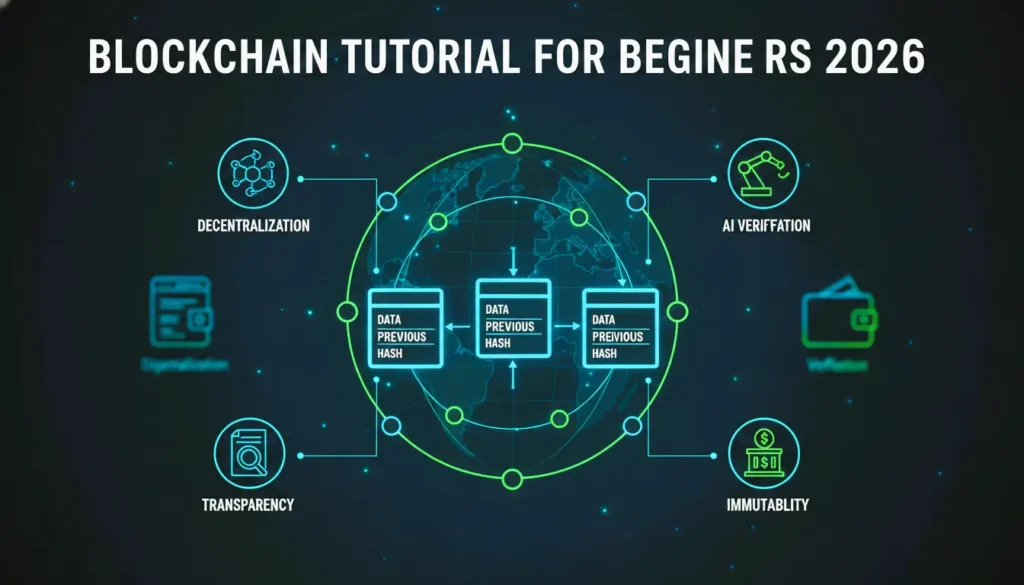
In 2026, a blockchain tutorial for beginners must define the technology beyond just “digital money.” At its core, a blockchain is a decentralized, distributed ledger—a shared digital notebook that records transactions across a global network of computers (nodes).
Unlike a traditional bank database controlled by one company, a blockchain is immutable. Once a “block” of data is verified and added to the “chain,” it cannot be deleted or altered without the consensus of the entire network. This creates a “shared source of truth” that is essential for modern finance, AI verification, and secure voting.
The Three Pillars of Blockchain Technology
To understand how it works, beginners should focus on these three concepts:
- Decentralization: No single entity (like a bank or government) has total control.
- Transparency: Every transaction is public and verifiable by anyone on the network.
- Immutability: Data is permanent. This prevents fraud and “double-spending” of digital assets.
How Does a Blockchain Work? Step-by-Step
Understanding the lifecycle of a transaction is the best way to grasp the technical flow.
1. Transaction Initiation
A user requests a transaction (e.g., sending 1.0 ETH or tokenizing a piece of real estate). This request is broadcast to a peer-to-peer (P2P) network.
2. Verification and Hashing
The network of nodes validates the transaction using a consensus mechanism. Each block is assigned a cryptographic hash—a unique digital fingerprint. If even one character of data changes, the hash changes completely, alerting the network to a security breach.
3. Block Creation and Linking
Once verified, the transaction is grouped with others into a new block. This block contains the hash of the previous block, mathematically linking them together into a chronological chain.
4. Finality
The block is added to the ledger, and the transaction is considered “confirmed.” In 2026, many networks achieve this “finality” in under a second.
Key 2026 Trends: AI, RWA, and DePIN
A modern blockchain tutorial for beginners isn’t complete without mentioning how the technology is used today.
- Real-World Assets (RWA): Institutional adoption has made it common to “tokenize” physical assets like gold, bonds, or property, allowing for fractional ownership.
- AI Verification: In a world of deepfakes, blockchain is used to “timestamp” and verify that a video or piece of code was created by a specific human or verified AI agent.
- DePIN (Decentralized Physical Infrastructure): People now use blockchain to earn rewards for sharing their internet bandwidth (5G) or dashcam data to build global maps.
Frequently Asked Questions (FAQs)
Is blockchain the same as Bitcoin?
No. Bitcoin is a type of cryptocurrency that uses blockchain technology. Think of blockchain as the operating system (like iOS or Android) and Bitcoin as an app (like WhatsApp) running on that system.
What is the difference between PoW and PoS?
- Proof of Work (PoW): Used by Bitcoin; requires “miners” to solve complex puzzles using electricity. It is extremely secure but energy-intensive.
- Proof of Stake (PoS): Used by Ethereum and Solana; selects “validators” based on how many tokens they “stake” as collateral. It is 99% more energy-efficient and faster.
Can a blockchain be hacked?
While theoretically possible via a “51% attack,” hacking a major public blockchain like Bitcoin or Ethereum in 2026 is practically impossible due to the massive amount of decentralized power required to overrule the network.
How do I start using blockchain?
The easiest way for a beginner is to set up a digital wallet (like MetaMask or Phantom). This allows you to interact with decentralized apps (dApps) and store your own digital assets securely.