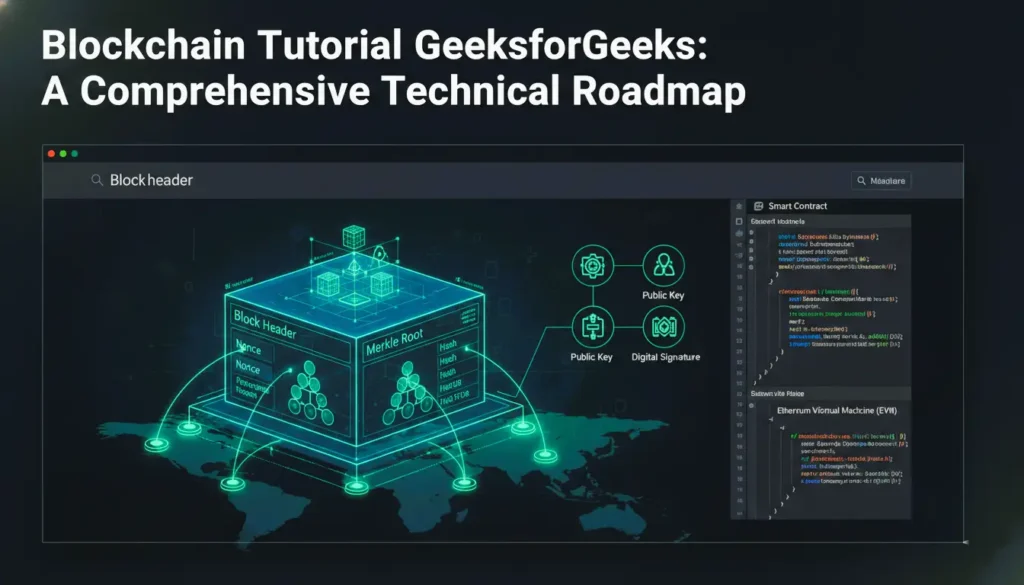
To master blockchain in 2026, one must move beyond the hype of cryptocurrency and understand the underlying data structures. This blockchain tutorial-inspired guide provides a deep dive into the decentralized architecture, cryptographic security, and smart contract logic that define modern Web3 development.
1. Fundamentals of Blockchain Architecture
A blockchain is a decentralized, distributed ledger that records transactions across a network of computers. Unlike traditional databases, it is append-only and immutable.
The Anatomy of a Block
Every block in the chain consists of specific data fields that ensure its integrity:
- Block Header: Contains the version, timestamp, and mining difficulty.
- Merkle Root: A mathematical way to verify all transactions in a block without downloading the entire data set.
- Nonce: A random number used in the “Proof of Work” mining process to find a valid hash.
Peer-to-Peer (P2P) Networking
In a blockchain tutorial, the P2P network is the backbone. There is no central server; instead, every “node” (computer) on the network maintains a copy of the ledger and communicates directly with other nodes to validate new entries.
2. Cryptographic Security and Consensus
The “trustless” nature of blockchain is achieved through complex mathematical algorithms.
Hashing and Digital Signatures
Blockchain uses asymmetric encryption. Every user has a public key (like an email address) and a private key (like a password). Transactions are signed with a private key and verified by others using the public key, ensuring that only the owner of the funds can initiate a transfer.
Consensus Algorithms
A core component of any blockchain tutorial GeeksforGeeks provides is the study of how nodes reach an agreement:
- Proof of Work (PoW): Requires computational power (mining) to secure the network.
- Proof of Stake (PoS): Requires “staking” tokens to act as a validator.
- Delegated Proof of Stake (DPoS): A more democratic version where stakeholders vote for delegates to secure the network.
3. Smart Contracts and the EVM
To become a blockchain developer, you must understand the Ethereum Virtual Machine (EVM)—the global “computer” that executes code.
Solidity: The Language of Web3
Most blockchain tutorial geeksforgeeks resources emphasize Solidity. It is an object-oriented, high-level language for implementing smart contracts. These contracts are self-executing agreements with the terms written directly into the code.
Short FAQs: Blockchain Tutorial
Q: Why is blockchain called a “chain of blocks”? A: Each block contains the hash of the previous block. If a single bit of data is changed in an old block, its hash changes, breaking the link for every subsequent block in the chain.
Q: What is a “51% Attack”? A: It is a theoretical vulnerability where an entity gains control of more than 50% of the network’s hash rate, allowing them to reverse transactions or prevent new ones from being confirmed.
Q: What is the difference between a public and private blockchain? A: Public blockchains (like Bitcoin) are permissionless and open to anyone. Private (or permissioned) blockchains (like Hyperledger) are restricted to authorized participants and often used in corporate supply chains.
Q: Can I use Python for blockchain? A: Yes! While Solidity is used for smart contracts, Python is excellent for building the core blockchain protocol, automation scripts, and interacting with Web3 APIs.