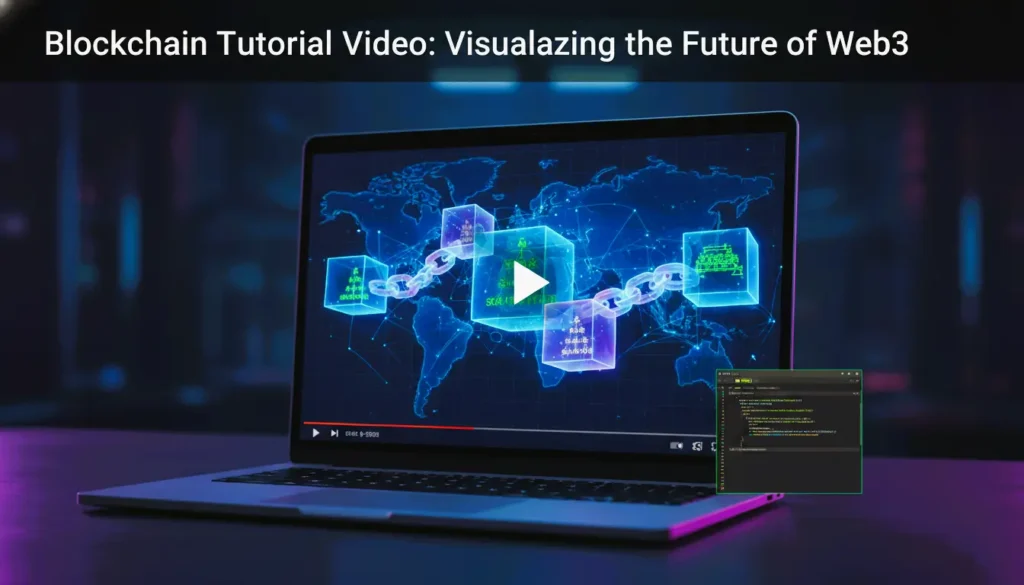
In the fast-evolving world of Web3, a blockchain tutorial video is often the most efficient way to bridge the gap between abstract theory and technical implementation. Visual learners can witness live coding sessions, see architectural diagrams in motion, and understand complex concepts like “Merkle Trees” far faster than through text alone.
Why Choose Video for Blockchain Learning?
Modern blockchain architecture is inherently three-dimensional. A high-quality blockchain tutorial video provides several key advantages:
- Live Coding Demonstrations: Watching an expert configure a Remix IDE or deploy a smart contract in real-time prevents common “copy-paste” errors.
- Visual Cryptography: Animations that show how SHA-256 hashing links blocks help solidify the concept of immutability.
- Network Mapping: Diagrams of Peer-to-Peer (P2P) nodes illustrate how decentralization actually functions across global servers.
Advantages of Interactive Video Learning vs Text Tutorials
-
Videos allow real-time debugging alongside the instructor.
-
Animations simplify complex concepts like Merkle trees, hashing, and P2P networks.
-
Retention improves because learners can see step-by-step execution rather than just reading code.
-
Replayable segments let learners pause, rewind, and practice at their own pace.
Recommended Tools to Follow Along
-
IDE/Editors: Remix IDE, VS Code with Solidity and Rust extensions.
-
Wallets: MetaMask or Phantom for testing smart contracts.
-
Testnets: Sepolia, Mumbai, or Solana Devnet to deploy contracts safely.
-
Libraries: Ethers.js, Web3.js, Anchor, or Substrate SDK, depending on the chain.
How to Choose the Right Blockchain Tutorial Video
-
Compare free vs. paid platforms: YouTube, Coursera, Udemy, and specialized Web3 academies.
-
Check instructor credibility: Look for blockchain developers with live project experience.
-
Verify updates for 2026: Solidity version, Ethereum 2.0, Layer 2 protocols, and ZKPs.
-
Look for interactive exercises: Videos with quizzes or coding challenges improve retention.
Essential Modules to Look for in a Tutorial Video
To ensure you are getting maximum ranking efficiency from your study time, look for a blockchain tutorial video series that includes these four pillars:
1. The Genesis: Understanding Distributed Ledgers
A solid intro video should explain the transition from centralized banking to distributed ledger technology (DLT). It must cover the “Byzantine Generals Problem” and how consensus prevents double-spending.
2. The Engine: Consensus Mechanisms (PoW vs. PoS)
Search for videos that visually compare Proof of Work (mining) and Proof of Stake (staking). Understanding the 2026 energy-efficient shift in networks like Ethereum is critical for modern developers.
3. The Logic: Solidity and Smart Contracts
This is the heart of the course. A top-tier blockchain tutorial video will walk you through:
- State Variables: How data is written to the chain.
- Functions: The logic that executes transactions.
- Security: How to avoid “reentrancy” and other common vulnerabilities.
4. The Interface: Building Your First DApp
The final module should show you how to connect a frontend (like React or Next.js) to the blockchain using Ethers.js or Web3.js.
Learning Path for Video-Based Blockchain Education
-
Step 1 – Foundation: Distributed ledger concepts, consensus mechanisms, and blockchain history.
-
Step 2—Smart Contracts: Solidity, Rust, and contract deployment on testnets.
-
Step 3—DApps & Frontend: Connecting blockchain to React, Next.js, or Vue.js using APIs.
-
Step 4 – Advanced Topics: Layer 2 scaling, zero-knowledge proofs, and Web3 identity (DIDs).
-
Step 5 – Capstone Project: Build a small NFT marketplace or token exchange using learned concepts.
FAQs: Blockchain Tutorial Video
Q: Can I learn blockchain development solely through video? A: A blockchain tutorial video is the best starting point, but you must supplement it by “coding along.” Open your editor and replicate the video’s steps to build muscle memory.
Q: What is the best platform for a blockchain tutorial video? A: YouTube remains the leader for free, community-driven content (channels like freeCodeCamp or Dapp University), while Udemy and Coursera offer structured, certificate-backed paths.
Q: Are 2026 blockchain videos different from older ones? A: Yes. Modern videos focus on Layer 2 scaling (Polygon and Arbitrum) and Zero-Knowledge Proofs (ZKPs), which were advanced topics in previous years but are now foundational.
Q: How long does a typical blockchain video course take? A: A comprehensive “Beginner to Pro” series usually ranges from 10 to 40 hours of video content, excluding the time you spend practicing.
Suggested Blockchain Tutorial Video Channels & Courses
-
YouTube Channels: freeCodeCamp, DappUniversity, EatTheBlocks.
-
Paid Platforms: Udemy – “Ethereum & Solidity: The Complete Developer’s Guide”; Coursera – Web3 Specialization.
-
Specialized Courses: Moralis Academy, Alchemy University, Buildspace Projects.
Pro-Tip for 2026 Learners:
When watching a blockchain tutorial video, always check the “Upload Date.” In the Web3 space, a video older than 12 months may use outdated library versions (like older Solidity compilers) that will cause your code to fail. Always filter for “This Year” for the most accurate syntax.
Tips for Maximizing Learning from Blockchain Videos
-
Code along in parallel: Open the IDE and replicate every example.
-
Take notes for key concepts and error solutions.
-
Join communities: Discord, Reddit, or Telegram groups to discuss video content.
-
Experiment beyond the video: Modify smart contracts, try Layer 2 solutions, or test on multiple chains.
-
Keep up with updates: Follow Solidity, Rust, or Substrate release notes.