In the current digital landscape, blockchain notes must reflect the shift from simple transaction recording to complex, programmable ecosystems. A blockchain is a decentralized, immutable, and distributed ledger technology (DLT) that uses cryptography to secure data across a global network of peer-to-peer (P2P) nodes.
The Anatomy of a Block
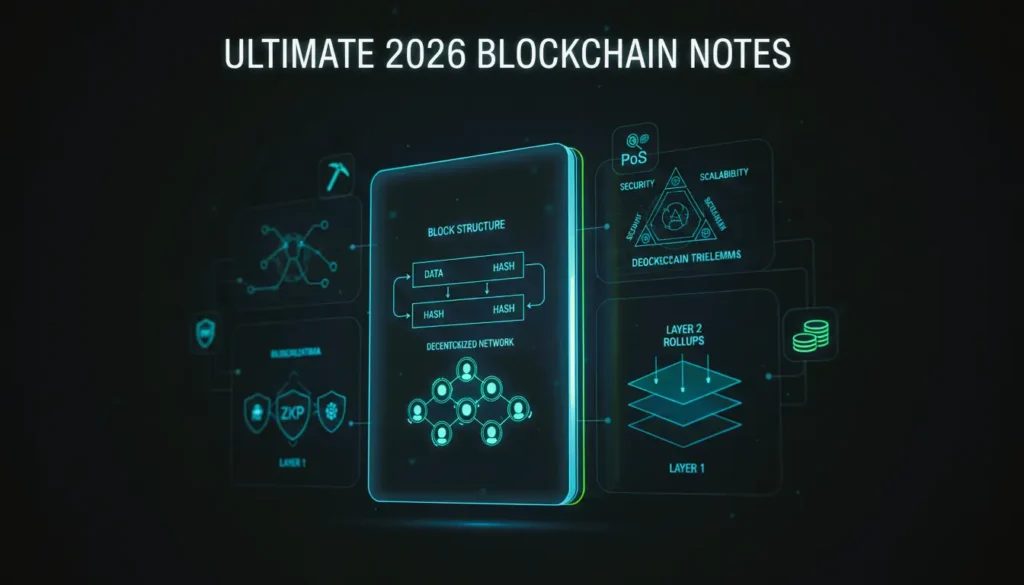
Every block in a modern chain is a data structure consisting of three primary components:
- Data: A collection of verified transactions or smart contract code.
- Hash: A unique cryptographic “fingerprint” (often SHA-256) that identifies the block and its content.
- Previous Hash: The pointer that mathematically links the current block to the one before it, creating the “chain.”
Key Technical Terminology for Your Notes
- Immutability: Once data is written to the ledger and confirmed by consensus, it cannot be altered without changing every subsequent block.
- Nodes: Computers that participate in the network, each holding an independent copy of the entire ledger.
- Genesis Block: The very first block in any blockchain, often hard-coded into the software.
Consensus Mechanisms and Security Protocols
Modern blockchain notes highlight how a “trustless” network reaches agreement without a central authority.
1. Proof of Work (PoW)
The original consensus model used by Bitcoin. Miners use computational power (ASICs) to solve complex puzzles. While highly secure, it is energy-intensive and often suffers from slower transaction speeds.
2. Proof of Stake (PoS)
The 2026 industry standard for energy efficiency. Validators “stake” their own assets to earn the right to verify transactions. This model significantly reduces energy consumption and allows for greater scalability.
3. Zero-Knowledge Proofs (ZKP)
A critical inclusion for advanced blockchain notes. ZKPs allow one party to prove to another that they know a piece of information without actually revealing the information itself, ensuring maximum privacy on public ledgers.
2026 Evolution: Layers and Modular Architecture
As blockchain technology matures, the focus has shifted toward solving the “blockchain trilemma”—balancing security, decentralization, and scalability.
The Rise of Layer 2 (L2) Scaling
L2 solutions, such as Optimistic and ZK-Rollups, process transactions off the main chain (Layer 1) before settling them in bulk. This allows networks like Ethereum to handle thousands of transactions per second (TPS) while maintaining the security of the underlying ledger.
Modular vs. Monolithic Blockchains
- Monolithic: A single chain handles data availability, consensus, and execution (e.g., Bitcoin, early Ethereum).
- Modular: A newer 2026 trend where different layers specialize in specific tasks. For example, one layer handles data storage while another handles transaction execution, dramatically increasing network efficiency.
Frequently Asked Questions (FAQs)
Why are blockchain notes important for professionals?
With the integration of Real-World Asset (RWA) tokenization and Central Bank Digital Currencies (CBDCs) into the global economy, having a technical grasp of blockchain is no longer optional for those in finance, supply chain, or legal sectors.
What is the “Blockchain Trilemma”?
Proposed by Vitalik Buterin, the trilemma suggests that a blockchain can only truly excel at two of three qualities: decentralization, security, and scalability. 2026 innovations like modularity and sharding are the industry’s attempt to solve all three simultaneously.
How does a smart contract fit into these notes?
A smart contract is a self-executing agreement where the terms are written directly into code. They are stored on the blockchain notes as programmable assets that execute automatically once predefined conditions are met, removing the need for intermediaries.
What is the difference between public and private blockchains?
Public blockchains (like Bitcoin) are open and permissionless—anyone can join and view the ledger. Private (permissioned) blockchains are restricted to authorized members, making them ideal for corporate use cases like the Hyperledger Fabric framework.