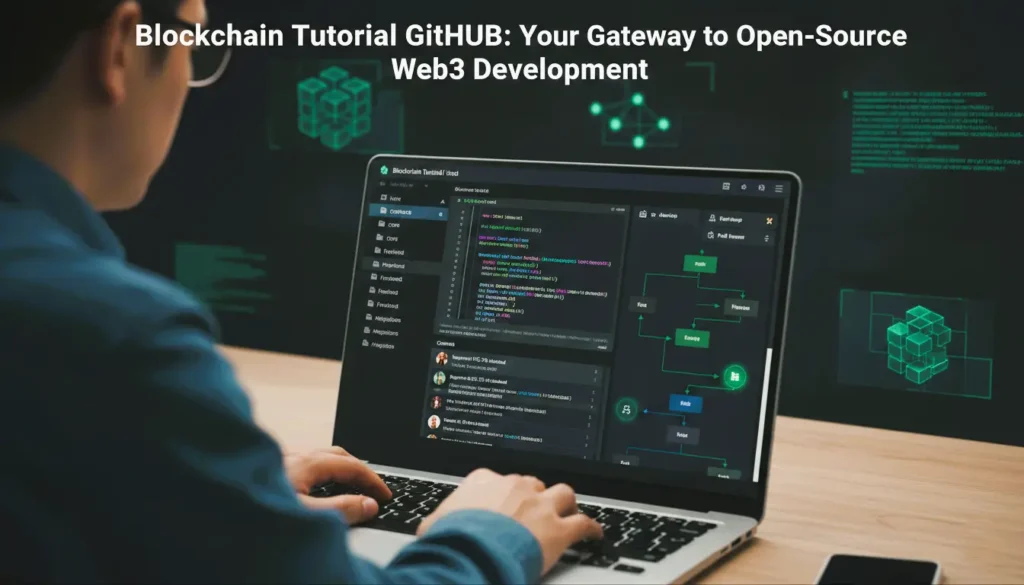
For developers, reading documentation is only half the battle. To truly understand decentralization, you need to explore real-world codebases. Using a blockchain tutorial GitHub approach allows you to fork repositories, experiment with smart contracts, and understand the internal logic of distributed ledgers.
Why GitHub is Essential for Blockchain Learning
Unlike traditional software, blockchain is built on the principle of transparency. Almost every major protocol—from Ethereum to Solana—is hosted on GitHub. Finding a high-quality blockchain tutorial GitHub repository offers the following:
- Version Control Mastery: Learn how protocols upgrade through “Hard Forks” and “Soft Forks” by tracking commit histories.
- Boilerplate Templates: Access pre-configured environments for Hardhat, Foundry, and Truffle.
- Security Audits: Study the code of audited protocols to understand how to prevent vulnerabilities like reentrancy attacks.
Core Modules in a Technical Blockchain Repository
A comprehensive blockchain tutorial. GitHub usually categorizes its code into specific clusters.
1. The Core Protocol (The Ledger)
This section typically contains code written in Go (Golang) or Rust. It handles the Peer-to-Peer (P2P) networking, the consensus engine (PoW/PoS), and the cryptographic hashing (SHA-256 or Ethash).
2. Smart Contract Implementation
Look for repositories that include a /contracts folder.
- Solidity: The standard for Ethereum Virtual Machine (EVM) chains.
- Move or Rust: Common for non-EVM chains like Aptos or Solana.
- ERC Standards: Learn how to implement ERC-20 (tokens) and ERC-721 (NFTs) by studying the OpenZeppelin GitHub libraries.
3. Frontend Integration (Web3.js & Ethers.js)
A “full stack” blockchain tutorial on GitHub will show you how to connect a React frontend to the blockchain. You will learn how to use hooks to detect browser wallets like MetaMask and interact with deployed contract ABIs.
Recommended Repositories to Fork in 2026
To maximize your learning efficiency, search GitHub for these specific curated lists:
- Awesome-Blockchain: A massive collection of links to whitepapers, tutorials, and tools.
- Smart-Contract-Best-Practices: Maintained by ConsenSys, this is the gold standard for secure coding.
- Build-Your-Own-Blockchain: Repositories that guide you through building a simple blockchain in Python or JavaScript from scratch.
FAQs: Blockchain Tutorial GitHub
Q: Why should I fork a blockchain tutorial GitHub repo instead of just reading code? A: Forking allows you to run the code locally, deploy it to a testnet (like Sepolia), and make changes without affecting the original project. It is the best way to “learn by breaking.”
Q: Do I need to pay to use these GitHub tutorials? A: No. One of the greatest advantages of a blockchain tutorial GitHub search is that the vast majority of resources are open-source and free to use under MIT or GPL licenses.
Q: What is a “README.md,” and why is it important in blockchain? A: In any blockchain tutorial on GitHub, the README file contains the installation instructions, dependencies (like Node.js version), and the “Contract Address” if the project is already live on a testnet.
Q: How can I contribute to these repositories? A: You can contribute by fixing bugs, improving documentation, or adding new features through “Pull Requests.” This is an excellent way to build a professional portfolio for Web3 jobs.
Pro-Tip: The “Git-Blame” Strategy
When exploring a complex blockchain tutorial on GitHub, use the `git blame` command. It allows you to see exactly who changed a line of code and why. In blockchain development, understanding the evolution of a security patch is often more valuable than the final code itself.
Conclusion
Using a blockchain tutorial GitHub repository is one of the fastest ways to move from theory to real Web3 development. By exploring open-source projects, studying smart contracts, and experimenting with decentralized applications, developers can gain practical experience that traditional documentation alone cannot provide.