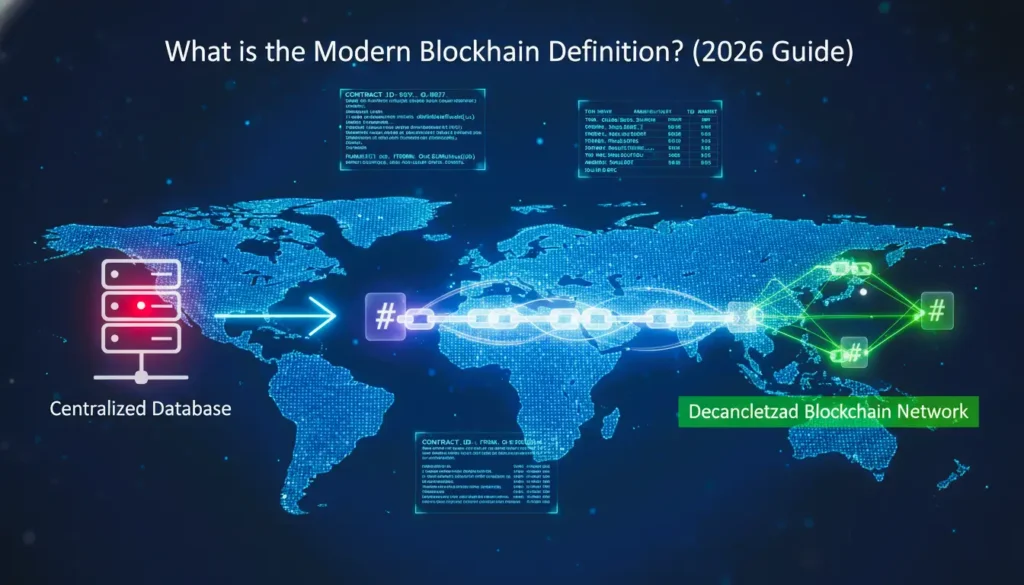
In 2026, a standard blockchain definition describes it as a decentralized, distributed ledger technology (DLT) that records transactions across a global network of computers. Unlike traditional databases, blockchain ensures that data is immutable—meaning once a “block” of information is verified and added to the “chain,” it cannot be altered or deleted without the consensus of the entire network.
At its core, blockchain serves as a shared source of truth. It removes the need for central intermediaries (like banks or government clearinghouses) by using advanced cryptography and consensus protocols to validate every data entry.
The 2026 Evolution: From “Crypto” to Infrastructure
While early definitions focused almost exclusively on Bitcoin, today’s blockchain definition encompasses its role as “trustless infrastructure.” It is now the backbone for:
- Real-World Asset (RWA) Tokenization: Digitizing physical assets like real estate and treasury bills.
- Institutional Compliance: Regulated frameworks (like the ADGM in 2026) that bridge traditional finance with digital ledgers.
- Automated Governance: Utilizing smart contracts to enforce business rules without human error.
Key Components of Blockchain Technology
To understand the blockchain definition fully, one must look at the technical pillars that make the system functional and secure.
1. Distributed Ledger Technology (DLT)
Instead of a single server, the database is copied across thousands of “nodes.” If one node fails or is hacked, the rest of the network remains secure, eliminating any “single point of failure.”
2. Immutable Hashing and Cryptography
Every block contains a unique cryptographic hash of the previous block. This creates a mathematical link that makes the history of the chain transparent and impossible to forge.
3. Consensus Mechanisms (PoS & PoA)
By 2026, most networks have moved toward Proof of Stake (PoS) or Proof of Authority (PoA). These methods allow nodes to agree on the validity of transactions efficiently while consuming 99% less energy than the older Proof of Work (PoW) models.
4. Self-Executing Smart Contracts
These are programmable “if-then” agreements stored on the blockchain. For example, a smart contract can automatically release payment to a vendor the moment a shipping sensor confirms a delivery.
Blockchain vs. Traditional Databases: The Critical Differences
| Feature | Traditional Database | Blockchain Technology |
| Authority | Centralized (Admin-controlled) | Decentralized (Network consensus) |
| Editability | Read, Write, Update, Delete | Read and Append-only (Immutable) |
| Trust Model | Trust in the institution | Trust in the mathematics |
| Transparency | Private/Restricted | Publicly auditable (for public chains) |
| Performance | High speed, high throughput | Secure, but requires sync time |
Frequently Asked Questions (FAQs)
What is a simple blockchain definition for beginners?
Think of blockchain as a digital “group chat” where everyone can see the messages, but no one can delete or change what has already been sent. It is a shared record-keeping system that everyone trusts because the math prevents anyone from cheating.
Is blockchain the same as Bitcoin?
No. Bitcoin is a cryptocurrency that uses blockchain technology. Blockchain is the underlying platform, similar to how the Internet enables email.
Why is immutability important in a blockchain definition?
Immutability ensures that once a transaction—such as a property deed transfer or a supply chain log—is recorded, it is permanent. This prevents fraud, double-spending, and unauthorized data tampering.
What are “Layer 2” solutions in 2026?
Layer 2 refers to secondary frameworks built on top of a main blockchain (Layer 1) to improve speed and reduce costs. They allow blockchain technology to handle millions of transactions per second, making it viable for everyday retail use.